
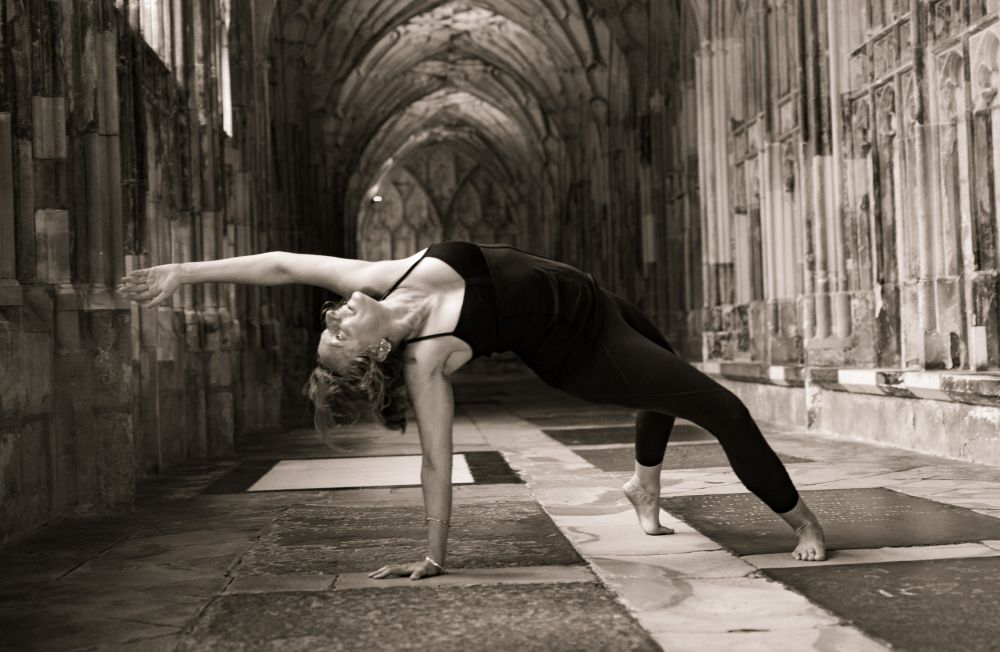
My Scaravelli-inspired yoga approach places the spine at the heart of our experience of vitality. When the spine is allowed to lengthen, soften and move freely, it can influence the way the whole body moves and feels – creating a sense of space, ease and connection from within.
When your spine is able to move freely, without unnecessary stiffness or muscular tension, movement can begin to feel more spacious and fluid.
And that’s a great feeling.
Rather than relying on constant muscular effort to hold ourselves upright, we can develop a more adaptable relationship with gravity, allowing our bodies to respond and reorganise as we move.
This doesn’t mean forcing your spine into a particular posture. In fact, healthy movement is much less about holding yourself rigidly upright and more about having enough mobility, strength and coordination to move easily between different positions.
A mobile spine also contributes to the way the rest of the body moves. Your spine provides a central link between your upper and lower body, and its ability to flex, extend, rotate and move in coordination with your hips, shoulders and rib cage can support more varied and efficient movement.
Space to breathe
Your spine and rib cage are closely involved in your breathing mechanics, and your movement and breath naturally influence one another.
When you’re able to move without unnecessary bracing or tension, your breathing may feel easier and more spacious.
For many, this combination of freer movement and easier breathing can simply feel calming – a sense of having more room to breathe, move and settle in the present moment.
Less effort, more responsiveness
When your spine has sufficient alignment, mobility, strength and coordination, movement can become more economical. Instead of bracing unnecessarily, you can adapt fluidly to changes in position, direction and load.
Over time, developing this kind of movement capacity can support physical function and help maintain confidence in everyday activities.
Supporting circulation
A healthy spine also has important effects on circulation. When muscles contract during physical activity, blood flow to those working muscles increases to help meet their demand for oxygen and nutrients.
Rather than thinking of your spine as something that needs to be held in a perfect position, it can be more useful to think of it as a system designed to move, adapt and respond.
As we age
Maintaining mobility, strength and coordination becomes increasingly valuable as we get older.
The aim isn’t to become endlessly flexible. It’s to retain enough mobility, strength and control to keep moving with confidence and choice.
That might mean turning to look behind you more easily, getting up from the floor, reaching overhead, walking comfortably, changing direction, or simply feeling more at home in your body.
Perhaps most importantly, a responsive spine can contribute to a greater sense of aliveness.
Movement can feel more fluid and connected. There can be less forcing and more responding – less effort spent holding yourself in place, and more freedom to move in the way the moment requires.
That is the quality we are looking for: not a rigidly straight spine, but a spine that is strong enough to support you, mobile enough to adapt, and responsive enough to move with you.
References
- Stathokostas, L., Little, R.M.D., Vandervoort, A.A. & Paterson, D.H. (2012). Flexibility training and functional ability in older adults: A systematic review. Journal of Aging Research, 2012.
- Zhang, S-K., Gu, M-L., Zhang, T. et al. (2023). Effects of exercise therapy on disability, mobility, and quality of life in the elderly with chronic low back pain: A systematic review and meta-analysis of randomized controlled trials. Journal of Orthopaedic Surgery and Research, 18, 513.
- Joyner, M.J. & Casey, D.P. (2015). Regulation of increased blood flow (hyperemia) to muscles during exercise: A hierarchy of competing physiological needs. Physiological Reviews, 95(2), 549–601.
- Scaravelli, V. (1991). Awakening the Spine. HarperCollins.