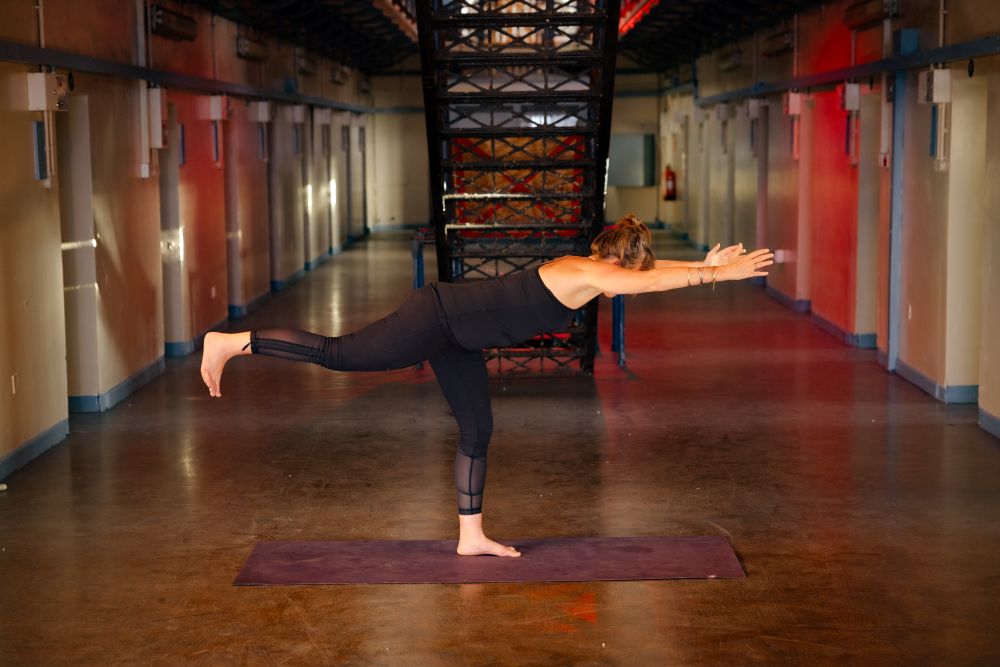
The way your body is organised and aligned – from your feet through your spine to the top of your head – influences how you move, feel and experience your body in everyday life.
Mindful movement practices such as yoga offer an opportunity to bring greater awareness to these relationships and explore subtle, helpful changes that can support how you move and inhabit your body.
When your body is able to move in coordination with itself and with gravity, your movement can become more efficient, less effortful and, for many people, more enjoyable.
Rather than constantly compensating, bracing or overworking, you can begin to develop a more responsive relationship with your own structure.
Your muscles, joints and connective tissues can work together as part of a coordinated whole, rather than each part having to work independently to keep us upright and moving.
At the heart of this is the idea of right relationship within the body.
This isn’t about finding a single, perfect posture or way of moving. Rather, healthy alignment is dynamic – it changes constantly as we walk, sit, reach, bend, breathe and respond to our environment.
When alignment is adaptable and movement is well coordinated, we may be able to perform everyday activities with less unnecessary muscular effort.
Patterns of holding
Yet most of us develop habitual patterns of holding: tight shoulders, a compressed-feeling lower back, locked knees, a head that habitually moves forward and/or a body shaped by hours spent sitting, driving or looking at screens.
These positions aren’t necessarily bad in themselves, because the body is remarkably adaptable. But difficulty arises when we become less able to vary our movement – when one particular way of standing, sitting or moving becomes habitual and other possibilities begin to disappear.
Movement may then start to feel restricted or effortful.
Yoga and other mindful movement practices provide a valuable opportunity to explore these patterns with greater awareness, gaining understanding to explore subtle, helpful changes that can support how you move and inhabit your body.
Finding support from the ground up
In practice, and something we explore in my yoga classes, this might mean becoming more aware of how your feet meet the ground, allowing your pelvis to move rather than fixing it in one position, exploring the natural curves and mobility of your spine, and allowing your head to balance more freely above your spine.
There is no need to force any of these changes. Instead, you can become curious about what happens when you give the body time, attention and appropriate movement.
Can your feet gain a clearer point of contact with the ground? Can your pelvis become more responsive? Can your spine fulfil its natural capacity to lengthen, flex, extend and rotate? Can your head become less something you consciously hold up and more something that balances through your whole bodily structure?
This way of working has strong philosophical connections with my Scaravelli approach to yoga. Scaravelli’s Awakening the Spine book describes her approach to working with the spine and the body’s relationship with gravity, rather than imposing a rigid external ideal of posture.
From effort to ease
When your movement is coordinated, different parts of your body can contribute to a task rather than one area doing more than its share. The result can feel lighter, more fluid and more responsive movement.
Over time, developing mobility, strength, coordination and body awareness can support physical function. Research into yoga and other exercise-based approaches suggests potential benefits for pain, disability and physical function, particularly in people with chronic musculoskeletal conditions.
Breathing, balance and vitality
Alignment and breathing are also closely connected through the movement of the ribcage, spine and diaphragm.
When we stop unnecessarily bracing and allow more movement through the torso, breathing may feel easier or more spacious. Breathing practices are also being investigated as part of approaches to spinal pain, although the evidence is still developing.
For many people, this combination of movement, breath and attention can create a greater sense of calm and physical ease.
And this is where the idea of vitality arises. Vitality doesn’t necessarily mean having more energy in a literal physiological sense. It can be the subjective experience of feeling more awake, responsive and connected to your body.
Perhaps one of the most noticeable changes is a return of natural lightness.
Walking can feel easier. Turning can feel freer. There can be a natural sense of bounce or spring in the body – not something forced or manufactured, but something that emerges when movement becomes more coordinated and less restricted.
Alignment is not perfection
This isn’t about striving for a rigid or idealised posture.
True alignment is dynamic, adaptable and responsive. It allows your body to change from moment to moment according to what you are doing.
The aim is not perfection, but awareness: learning to sense how your body is organising itself and exploring other possibilities with curiosity.
Over time, this way of moving can change not only how your body functions, but how it feels to live in it.
References
Exploring the therapeutic effects of yoga on spine and shoulder mobility: A systematic review (2024).
This review found that yoga interventions have the potential to improve spinal flexibility and mobility.
Ward, L. et al. (2013). Yoga for functional ability, pain and psychosocial outcomes in musculoskeletal conditions: A systematic review and meta-analysis.
Found evidence of improvements in functional outcomes and pain across a range of musculoskeletal conditions.
Scaravelli, V. Awakening the Spine
The key reference for the Scaravelli-inspired philosophy underpinning this approach. Scaravelli’s work explores the spine, gravity, grounding and breath, with an emphasis on listening to the body rather than imposing a rigid model of alignment.
Feldenkrais, M. Awareness Through Movement
A foundational movement-education text exploring posture, breathing, coordination, awareness and the relationship between skeletal organisation and muscular effort.
Franklin, E. Dynamic Alignment Through Imagery, 3rd ed.
A detailed movement and anatomy reference exploring dynamic alignment, body awareness, imagery, coordination and efficient movement.